At Zero Zone, the gold standard is a crystal: a Crystal Merchandiser®. These reach-in display cases have served retailers across every application: beverage, dairy, deli, meat, produce, and frozen food. To understand why, let’s look at 5 reasons that retailers love the Crystal Merchandiser®.
#1: Excellent Energy Efficiency
Up to 84% less energy than open multi-decks
Up to 45% less energy than other reach-in coolers
We know what matters most of all, and that is profit and cost. The Crystal Merchandiser® is the clear choice for maximizing profit while minimizing operating cost. These cases were engineered for excellent energy efficiency, especially against open multi-deck cases (up to 84% less energy) and even against other reach-in coolers (up to 45% less energy).
A retailer’s vice president of facilities and equipment said, “The energy savings are what really make you stop and say, ‘I need to take a serious look at this’. Then you start getting into things that become more apparent once you have the cases in—the comfort in the aisle, how great the product labels appear from the LED lighting—all of those subsequent advantages.”
#2: 74″ Tall CoolView® Doors
Not only do Zero Zone cases have excellent energy efficiency, but they are energy efficient while also having some of the largest doors in the industry. These 74″ tall doors open up the Crystal Merchandiser® to shoppers, making it easy for them to see products and make their selection.
Our 30″ wide CoolView® Illusion® doors for our low-temperature cases are known for glass that goes all the way to the edge of the door, giving the impression that the case is open even when the door is closed. The effect is most dramatic for a lineup of cases where the aisle will look like a wall of enticing product. Shoppers may be under the illusion that the door is not even there.
Crystal Merchandiser® Low Temp RVLC30 with CoolView® Illusion® Doors
The medium-temperature cases use CoolView® Ultra™ doors, which are notable for their broad display and slender frames. These are available as either 24″ wide French-swing doors or as 30″ wide single-swing doors. This lets retailers pick the right door to fit their merchandising strategy and store planogram.
#3: More Facings & More Packout
With taller doors comes increased product facings: up to 35% more facings than other display cases. In addition, the Crystal Merchandiser® also offers more merchandising space with 6 full shelves, which means up to 25% more packout. “We are able to get an entire case of 6-packs out as well as 3 12-packs on each shelf,” a liquor store manager noted. “You might think that with 6 shelves instead of 5, it might be more difficult for the consumer to pull product off of the shelving, but it has actually been easier.”
For even more space, take a look at the Zero Zone Deep cases, which allows you to fit 4 30-packs of 12 oz. cans in the bottom basket.
Crystal Merchandiser® Medium Temp RVMC30D Deep Case
Extra space can be valuable in any department in a store. Another store manager said, “In the yogurt section, with the old open cases that weren’t self-feeding, you would have to restock after you sold 6 units—or pull it all forward. But in this situation, you fill it once, you go back in mid-day and refill it. I mean, the labor savings is astronomical—about an hour and a half a day. That’s one of the ways we’ve been able to cut some inefficiencies.”
#4: More Efficient Use of Floor Space
Part of the genius of the Crystal Merchandiser® is that in addition to offering more facings and packout, the case actually uses less floor space within stores. The Crystal Merchandiser® is only 39 1/2″ from the back of the case to the front of the door handle. It is up to 7″ narrower than multi-deck cases. This allows retailers to use that space elsewhere or to simply have wider aisles, which shoppers appreciate.
#5: Reduced Shrink & Increased Shelf Life
The Crystal Merchandiser® also helps stores by reducing product shrink and increasing shelf life, which is especially pertinent to meat departments and produce departments.
In the words of a meat department manager, “Are the products holding up better? Absolutely! There’s no question it’s enhanced the shelf-life of the products.” The manager also reported that the meat held its vibrant, fresh color longer. A meat cutter told us, “It actually preserves the meat longer, gives it more life. It’s better for the customer; they get a fresher product. It’s better for us, as a company; we save more money, and we sell more, too.”
This benefit carries over to the produce department. Anything you put in the Crystal Merchandiser® stays fresh and beautiful longer. Spoilage is down, and shoppers take home produce that is fresher. As a produce department manager told us, “Since we began using the Crystal Merchandiser®, our shrink on bagged salad and cut fruit has been reduced by as much as 50%. The consistent temperature is the key.”
Are You Ready?
Have you fallen in love with the Crystal Merchandiser® too? Now is the time to contact the Zero Zone sales team to choose the Crystal Merchandiser® for your next store.

The Genesis of Refrigeration
Genesys™ Natural Refrigeration Solutions takes us back to the beginning. Carbon dioxide (CO2) and ammonia (NH3) have always been in our environment, and they have also always been part of the story of refrigeration. Both served as refrigerants in the 1800s. However, synthetic refrigerants emerged, causing their use to decline. Now, the AIM Act and upcoming EPA rules will propel the industry away from environment-damaging HFC refrigerants and toward low global warming potential (GWP) options. Consequently, natural refrigerants are once again a rising option for refrigeration.
Introducing Genesys™ Natural Refrigeration Solutions
That is why Zero Zone presents Genesys™ Natural Refrigeration Solutions. It is time to return to the beginning—the genesis—of refrigeration with CO2 (R-744) and ammonia (R-717) systems. CO2 and ammonia are the gold standard for ozone depletion potential (ODP) and global warming potential (GWP). Neither depletes the ozone (0). CO2 has a GWP of 1, as it is used as the baseline for that scale, and ammonia has a GWP of 0. For performance, CO2 is known for its high cooling capacity, and ammonia has a reputation for excellent energy efficiency. Natural refrigerants are a future-proof solution that exceeds modern sustainability goals, allowing customers to make the best choice for themselves and for the environment. Natural refrigerants are the natural choice.
The Time to Act is Now
Upcoming EPA regulations will end the use of most HFC refrigerants by 2025. Therefore, today is the day to choose Genesys™ Natural Refrigeration Solutions for your next project. For more information about the Genesys™ CO2 systems, watch our video and learn more at our website.
The American Innovation and Manufacturing Act (AIM Act) directs the Environmental Protection Agency (EPA) to regulate the transition to alternative refrigerants. It phases down the production and consumption of HFC refrigerants. The EPA has published a proposed rule that will prohibit the manufacture of equipment containing HFCs by January 1, 2025. It will also prohibit the sale of those products by January 1, 2026.
Read more about the AIM Act in 2025 here.
Which states are affected by the AIM Act?
This rule would apply to the entire country, bringing alignment instead of state-by-state regulations. States can still issue their own, more stringent regulations. Some states, like California and New York, will still require attention.
Which refrigerants are affected?
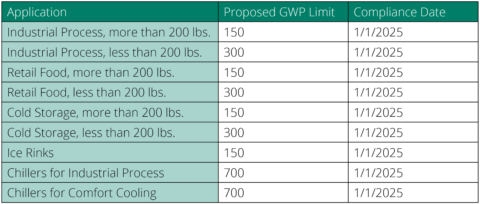
This rule proposes to restrict the use of refrigerants by their global warming potential (GWP). Equipment using more than 200 lbs. of refrigerant will face a GWP limit of 150. Equipment using less than 200 lbs. of refrigerant will face a GWP limit of 300. Chiller systems will face a GWP limit of 700.
These GWP limits will end the use of refrigerants like R-404A (GWP of 3943), R-407A (GWP of 1923), R-410A (GWP of 1924), R-448A (GWP of 1273), R-449A (GWP of 1282), and R-507 (GWP of 3985) in new equipment. Refrigeration equipment will need to use natural refrigerants, such as CO₂ (GWP of 1) and ammonia (GWP of 0). HFO-based refrigerants will also be used since they have options below the proposed GWP limits.
When will the AIM Act ruling be finalized?
Currently, the proposed rule is available for comments until January 30, 2023. The rule will be finalized in October 2023. We do not expect the GWP limits to change. However, the implementation date might get pushed back to help manufacturers and end users complete existing projects. Industry leaders are asking for clarification about how the implementation dates are defined. They also seek clarification on how “new projects” will be defined compared to retrofit or remodel projects.
Further Reading
Zero Zone has a new paper, “The National Plan for Refrigerant Regulations,” which has more information about the upcoming EPA regulations, which states will still have regulations to follow, and solutions that Zero Zone offers.
To know where we have come from, Zero Zone has a paper, “The State of Refrigerant Regulations,” which covers state regulations that affected the United States from 2019 through 2024.
The proposed rule and a succinct fact sheet are available on the EPA website: https://www.epa.gov/climate-hfcs-reduction/technology-transitions.
If you have questions about these regulations, please contact Zero Zone and ask to speak to our Director of Regulatory Compliance & Refrigeration Technology. If you want to learn about our offerings and plan for these regulations, contact our sales team.
NASRC Factsheet on Natural Refrigerants
The North American Sustainable Refrigeration Council (NASRC) recently published a factsheet outlining the impact of natural refrigerants on supermarket refrigeration. We aim to circulate this factsheet to ensure people do not miss this valuable resource and reminder of the benefits of natural refrigerants. The NASRC advocates for natural refrigerants. In their words, “Natural refrigerants are the climate-friendly solution to mitigate supermarket HFC emissions.”
Zero Zone Natural Refrigerant Systems
Zero Zone offers natural refrigerant systems using CO₂ or ammonia. Our equipment serves both commercial and industrial settings, ranging from 5 tons to 500 tons. Additionally, our Natural Refrigerant Systems product sheet demonstrates the variety of systems we have designed and put into service. We provide CO₂ and ammonia system solutions to meet various requirements for cold storage, food processing, pharmaceutical operations, and supermarkets. Furthermore, we incorporate secondary glycol loops, air-cooled or water-cooled condensing, heat reclaim systems, and more.
CO₂ Systems
We offer CO₂ subcritical and CO₂ transcritical systems. CO₂ systems can be indoors or outdoors, set up inside custom electrical mechanical centers (CEMCs), built as full racks or condensing units, and be part of booster systems and cascade systems. This versatility unlocks CO₂ as a viable solution for warm and cool climates for all sorts of customers, and Zero Zone has been shipping these systems across the United States with great results.
Ammonia Systems
Ammonia is a great choice for industrial customers and ice arenas. Low-charge ammonia systems can be utilized indoors, outdoors, and in CEMCs. We have many years of experience and knowledge in ammonia, and we are ready for your project.
EPA Regulations and Assistance
With increasing EPA regulation limiting the continued use of HFC refrigerants, Zero Zone is eager to assist you with deciding which natural refrigerant system would be best adapted to your specific application. Begin a conversation with us. Contact your local Zero Zone sales rep today.
Not even refrigeration regulations are simple after 2020. Refrigerant regulations are changing, and getting new refrigeration equipment is complicated. This adds more challenges to stores, cold storage warehouses, pharmaceutical plants, and more.
Here is the brief summary of recent refrigerant regulations. The United States Environmental Protection Agency (EPA) issued SNAP Rules 20 and 21 in 2015 and 2016 to eliminate the use of refrigerants with high global warming potential (GWP), but those rules were vacated by the D.C. circuit court in 2017 and 2019. Since then, individual states have taken responsibility for issuing their own regulations. So far, most state regulations target the same high GWP refrigerants, but they have different effective dates and even define the effective dates differently. This creates a challenge for both buyers and manufacturers who need to know whether their new equipment will be compliant.
Zero Zone wants to help by providing the effective dates and a map so it is clear whether your state has any regulations. Check out our article about The State of Refrigerant Regulations. Please note that we recommend that our customers contact their state’s environmental regulatory department to clarify the nuances, but our research will be a valuable starting point.
“You asked, we answered.” That has been the motto for the Reveal Merchandiser® ever since it was launched in 2017. Through the years, we have expanded this product line again and again based on customer feedback, as you’ve seen with our Tall, MX, PX, and Hybrid™ options. And now, we are excited to announce that the Reveal Merchandiser® can be ordered (drumroll, please)… with doors!
Retailers sought a display case with the sleek design and merchandising flexibility of the Reveal Merchandiser® open multi-deck, but with the energy savings of a reach-in case. It was an open and shut case… Reveal™ with Doors to be exact. The Reveal™ with Doors case gives you all the merchandising capabilities you know and love about the standard Reveal Merchandiser®: deep shelves, deep bottom wire racks, beautiful ChillBrite® LED lighting, and equally versatile horizontal or vertical merchandising strategies. But, the best part? Reveal™ with Doors can lower energy costs by up to 71% compared to open multi-decks! Refrigeration equipment runs 24 hours per day, so there’s no denying, putting doors on cases significantly reduces energy costs and improves product shelf life.
Thinking of something with doors? Open the door to having it all in one. Learn more about the Reveal Merchandiser® with Doors and contact your sales representative today!
Press Release
North Prairie, WI—June 7, 2020—Zero Zone, a leading manufacturer of refrigerated display cases and refrigeration systems, announces the introduction of the Zero Zone Reveal Merchandiser® with Doors display case product line.
Food retailers have long expressed their love of the original Reveal Merchandiser® open multi-deck cases for their horizontal merchandising platform and easy access to products. They have increasingly asked for a closed-case version with glass doors for certain applications in order to help control their burgeoning energy costs. The Reveal Merchandiser® with Doors gives them the best of both worlds: as much as 71% energy reduction (compared to open multi-decks) and the ability to merchandise their products either in a 48-inch horizontal planogram or in a 24-inch vertical planogram.
According to Dan O’Brien, VP of Sales & Marketing for Zero Zone, “the Reveal Merchandiser® with Doors complements its other Zero Zone display case counterparts, creating a sleek, consistent appearance throughout the store. Choosing Zero Zone merchandisers helps retailers pull together the look of their entire store design.”
The Reveal Merchandiser® product line has flourished and grown since its introduction in 2017, adding Tall, Meat Exclusive (MX), Produce Exclusive (PX), Hybrid™, and now Reveal™ with Doors. Whatever the case may be, the Reveal Merchandiser® with Doors is the open and shut case for merchandising flexibility and energy savings.
Learn more about the Zero Zone Reveal Merchandiser® with Doors line of products.
About Zero Zone
Established in 1961, Zero Zone has display case facilities in North Prairie, Pewaukee, and Waukesha, WI, and a refrigeration systems plant in Ramsey, MN. Zero Zone is a leading manufacturer of refrigerated glass door display cases, open multi-decks, and commercial refrigeration systems for supermarkets, drug, dollar, and convenience stores, and manufactures industrial refrigeration systems for cold storage, food processing, ice arenas, and the pharmaceutical/biomedical industry.
Reveal Merchandiser® is a registered trademark of Zero Zone, Inc. in the United States.
Refrigeration engineers and service contractors need to understand the difference between bubble point (when a substance starts boiling) and dew point (when a substance finishes boiling) because high-glide refrigerants do not boil at a constant temperature. If refrigeration professionals do not know these terms or use them incorrectly, equipment will be inefficient and possibly be damaged. Let’s glide into this discussion about high-glide refrigerants.
Refrigerant Glide
Water boils at a consistent temperature. When you set a pot of water to boil, the water will boil at the same temperature whether the pot holds 1 cup of water or 2 cups of water. Even as the water evaporates, the remaining water boils at the same temperature. This is because the only substance being boiled is water.
Many refrigerants also have a consistent boiling point, whether they are natural refrigerants or synthetic refrigerants. But high-glide refrigerants do not boil at a consistent temperature. A high-glide refrigerant may start boiling at 18°F, but as it boils into a gas, the boiling point “glides” up to 28°F. Why does this happen? High-glide refrigerants are a blend of different refrigerants, and these refrigerants separate when they are brought to boiling. Since each refrigerant boils at different temperatures, they will evaporate into a gas at different points, which changes the composition and concentration of the remaining liquid refrigerant. This causes the boiling point to “glide.”
Let’s consider a high-glide refrigerant that is composed equally of three different refrigerants, and each boil at different temperatures; for example, 18°F, 23°F, and 28°F.
- Below 18°F, the composition is completely liquid and not boiling.
- At 18°F, the first refrigerant boils away. This changes the composition and concentration of the refrigerant blend, and the remaining refrigerants will boil at a higher temperature.
- At 23°F, the next refrigerant in the composition boils away, changing the composition and concentration again.
- At 28°F, the final refrigerant boils away. The entire refrigerant blend evaporates into a gas, and the boiling point “glides” up to 28°F.
Bubble, Mid, & Dew Point
For refrigerants without a glide, it is simpler to design a system because the refrigerant boils at the same temperature throughout the operation. But with high-glide refrigerants, the equipment could be designed for either when the refrigerant starts to boil (evaporate), when it has partially boiled, or when it has fully evaporated.
Refrigeration engineers and service contractors need to be familiar with the terms bubble point, mid point, and dew point.
- Bubble point: Liquid refrigerant starts to boil at this pressure and temperature in the evaporator.
- Mid point: Half of the liquid refrigerant has boiled away to a gas.
- Dew point: The last of the liquid refrigerant boils away.
To remember these terms, think about how a liquid bubbles as it boils or how dew forms in the morning when water vapor condenses.
The terms bubble point and dew point need to be understood and applied when discussing high-glide refrigerants. If the equipment does not specify bubble or dew point, the contractor could operate it incorrectly. Bubble point and dew point can be very different, as seen in the previous example (18°F versus 28°F). Warning: If there is ambiguity about whether equipment was designed for dew point, mid point, or bubble point, ask the equipment manufacturer. Do not make assumptions and risk damaging the equipment by running it incorrectly.
Consider This
There are two things worth mentioning to further our discussion. First, the terms bubble, mid, and dew point must be applied differently when talking about condensers on the high side of the refrigeration cycle. The condenser starts at the dew point as vapor refrigerant begins to condense into a liquid, and it finishes at the bubble point as the vapor refrigerant completely condenses into a liquid.
Second, there are also low-glide refrigerants. Low-glide refrigerant blends do not separate as much as high-glide refrigerants when they boil, so the bubble point and dew point are closer together. However, even a small temperature difference affects how equipment is sized and used. It is still important to know the difference between bubble point and dew point for any refrigerant that has a temperature glide.
These are just the basics about temperature glide, but hopefully you can already understand the importance of knowing the terms bubble point, mid point, and dew point.
Using High-Glide Refrigerants
High-glide refrigerants are more complex because of the glide. Why would someone want their system to use high-glide refrigerants? These blended refrigerants were developed specifically to have less of an impact on the environment. Older synthetic refrigerants had high ozone depletion potential (ODP) and high global warming potential (GWP). Refrigerant manufacturers have developed high-glide refrigerants to have low or no impact on the ozone layer and global warming. High-glide refrigerants are gaining popularity because of this, but the glide leads to some new challenges when designing and servicing a refrigeration system.
Have questions? Contact us and ask for our Director of Regulatory Compliance & Refrigeration Technology.
We take our home refrigerators for granted. We put food into the refrigerator, and it makes the food cold. But actually, the refrigerator is not making the food cold; it is removing heat from the food. That might sound counterintuitive, so we invite you to open the door to the world of refrigeration by learning about the basics of the refrigeration cycle.
Heat Transfer & Pressure
Before we discuss the refrigeration cycle, we must briefly discuss heat transfer. Heat always transfers from warm to cold. You can see evidence of this in your beverage of choice. Your morning coffee may start hot, but as the day wears on, it gets cooler because heat transfers into the surrounding air. At lunch, your soda warms up as heat transfers from the surrounding air. This is called sensible heat transfer. You can remember this by thinking about how you can sense (feel) the change. The coffee mug feels hot as heat transfers to you; the soda can feels cold as heat transfers from you.
Heat transfer can also cause a substance to change state between solid, liquid, and gas. This is called latent heat transfer. For example, H2O can exist as a solid (ice), a liquid (water), or a gas (steam). At sea level, H2O will be water between 212°F (100°C) and 32°F (0°C). If water is heated beyond 212°F, it will evaporate into steam. If water is cooled below 32°F, it will freeze into ice. As a substance changes state, its original state will be reduced as the other state increases. For example, as ice melts, it disappears and the amount of water increases. If enough heat transfers, the substance will cease to exist in its original state. Latent heat transfer (changing state) takes more heat than sensible heat transfer (changing temperature).
Another factor is how pressure relates to temperature. Boiling points vary depending on the pressure surrounding the substance. At sea level, water boils at 212°F, but if you travel to Denver or Pikes Peak in Colorado, the atmospheric pressure is lower and the boiling point will be lower.
The Refrigeration Cycle
Your unfinished can of soda is now warm. How do you chill it again? You may think the answer is to add cold to it, but remember that heat only moves from warm to cold. It is more accurate to say that you are actually removing the heat from the soda by transferring that heat to another, colder object. This is the concept behind the refrigeration cycle.
The refrigeration cycle comes from the work of William John Macquorn Rankine, who discovered how to transfer heat away from objects that were already cool. Historically, this could be done by placing objects into an ice box. Ice works well as a refrigerant because it maintains a constant 32°F temperature. Warm product (milk, meat, etc.) transfers heat to the ice (latent heat transfer), causing the ice to melt into water. The water (full of heat) drains away, and the refrigerated space and product remain cool.
All modern refrigeration systems have four main components that work together to move heat: the evaporator, the compressor, the condenser, and the expansion device. Imagine that heat moves in a “bucket” and follow the bullet points which correspond to the figure.
- The evaporator gathers/absorbs heat from the refrigerated space into a “bucket.” The “bucket” is low-pressure, and it changes state (latent heat transfer) as it absorbs heat. Then the evaporator moves the low-pressure, heat-filled “bucket” to the compressor.
- The compressor applies pressure, which compresses the heat-filled “bucket.” The heat-filled “bucket” changes from low-pressure to high-pressure as the compressor pushes it from the colder evaporator to the warmer condenser. When pressure is added, the temperature of the “bucket” also increases.
- The condenser takes the high-pressure, heat-filled “bucket” and releases the heat from the “bucket” to the outside air (or other application). The “bucket” changes state (latent heat transfer) again as it releases heat.
- The expansion device relieves the pressure on the empty “bucket.” When pressure is reduced, the temperature also decreases. The “bucket” cools and expands on its way to the evaporator to absorb more heat again.
The downside of using ice as the “bucket” is that more ice must constantly be added as it melts away. Modern refrigeration systems needed a long-term solution. Refrigerants are the modern “bucket” because refrigerants can continually absorb and release energy without escaping the system. Refrigerants change state between a liquid to a gas. Refrigerants must be able to boil at low pressures and low temperatures to be efficient.
High-glide refrigerants have a unique effect on a refrigeration system.
Have questions? Contact us and ask for our Director of Regulatory Compliance & Refrigeration Technology.
The pursuit of perfect product presentation is a constant endeavor for retailers, especially those dealing with fresh perishables. The original Reveal Merchandiser® has long been a staple in the refrigeration world. It is a versatile open multi-deck case that retailers rely on for medium temperature applications. Its popularity stems from its reliable performance and adaptable design and our customers tell us they love it! However, at Zero Zone, we believe in continuous improvement. We are driven by the invaluable feedback of our customers. When they asked, “How can we further enhance the freshness and visual appeal of red meat and produce?” we listened. The result? The revolutionary 4-deck Reveal™ MX (meat exclusive) and 3-deck Reveal™ PX (produce exclusive) open multi-deck cases.
The inherent allure of fresh meat and produce lies in their vibrant colors and natural appeal. The bright red of premium cuts and the dazzling hues of ripe fruits and vegetables are powerful visual cues that draw shoppers in. Recognizing this, we engineered the Reveal™ MX and PX open multi-deck cases to amplify these natural qualities. Our design philosophy centers on maximizing product freshness while presenting it in its most appealing light. The sleek, clean exterior of these cases provides an unobstructed view of the merchandise. The spacious interior ensures excellent packout, allowing for ample product display.
Multi Deck Case Lighting
A critical element in showcasing fresh products is lighting. The Zero Zone ChillBrite® LED lighting system is integrated into the Reveal™ MX and PX open multi-deck cases to provide bright, even illumination. This lighting highlights the natural beauty of the merchandise. This superior lighting enhances the visual appeal of the products. It also contributes to a more inviting and engaging shopping experience.
Customization
Understanding that every retail environment is unique, we’ve designed the Reveal™ MX and PX open multi-deck cases with a high degree of customization. Retailers can choose between a variety of options! This includes two case heights (75″ or 80″ for MX; 80″ or 82” for PX), two sill heights (low or medium), optional windowed ends, and optional glass fronts. This flexibility allows retailers to tailor the case configuration to their specific needs. This ensures optimal product presentation and store layout.
The Reveal™ MX and PX open multi-deck cases are more than just display units; they are strategic tools that empower retailers to gain a competitive edge. By presenting fresh meat and produce in their most appealing form, these cases encourage repeat business and foster customer loyalty. In today’s competitive market, the ability to showcase products effectively is paramount. The Reveal™ MX and PX open multi-deck cases provide the perfect platform to do just that, ensuring that your shoppers keep coming back for more. Choosing the Reveal Merchandiser® MX or PX is not just an investment in equipment; it’s an investment in the success of your fresh food offerings.
Visit the Reveal Merchandiser® page to learn more!