Let’s talk about hockey. Or do you prefer figure skating? Maybe you’re a little nerdy (like us!) and want to talk about CO2 transcritical refrigeration. You are in luck, because the St. Michael-Albertville (STMA) Ice Arena has all of that!
The STMA story is about an ice arena that had too many skaters and not enough ice time to go around. The STMA School District replaced their existing system with a Zero Zone ColdLoop™ Ice Arena Chiller that cools both their original ice sheet and a new ice sheet. Terry Zerwas, the school’s Director of Buildings & Grounds, described the transition as “flawless,” and their Activities Director Keith Cornell spoke about how this gives the boys’ and girls’ hockey teams a real home. Their rink is ready for hockey players and figure skaters alike. “An Olympic skater had a program here,” explained Terry Zerwas, “and that Olympic skater found that it was the best that they had skated on.”
St. Cloud Refrigeration (SCR) was responsible for installing the ColdLoop™ Chiller. SCR Owner Mark Fitch says their relationship with Zero Zone goes back 40 years. “We’ve always been very familiar with Zero Zone’s equipment. They put together a very nice product for us.”
The design team chose CO2 as the primary refrigerant that works with a secondary glycol loop. Arena Manager Grant Fitch believes CO2 could be “the future” for ice rinks, and Mark Fitch is confident that “CO2 will be around and will not be phased out and will actually get bigger and bigger as time goes on.” CO2 is a very efficient and safe refrigerant. People question CO2 because it operates at very high pressures, but Mark Fitch says that is not a big concern. “Every component is built to deal with this pressure,” he states, comparing the system to other high pressure applications in homes and apartments. If high pressure is there, the system will be built to accommodate it.
This is just the tip of the iceberg. Want to know more? You don’t even need to travel to Minnesota. Watch our video or read our full case study about the STMA Ice Arena to see it for yourself. Learn about our full capabilities in our new ColdLoop™ Ice Arena Chillers Brochure.
The Crown Coliseum in Cumberland County, NC, is home to the Fayetteville Marksmen minor league hockey team. It also became the home to a brand new Zero Zone ColdLoop™ Ice Arena Chiller.
After years with an old R-22 system, Cumberland County turned to Zero Zone for a new chiller using ammonia. Ammonia is an industrial-grade refrigerant. “Ammonia as a refrigerant is an excellent choice,” Industrial Sales Manager John Collins explained. “It is perfectly suited for a low-temperature chiller application: highly efficient and very reliable.” Ammonia is a future-proof refrigerant with no ozone depletion potential (ODP = 0), no global warming potential (GWP = 0), and high performance. It is one of the most prominent natural refrigerants, which is appealing as an environmentally responsible option.
Cumberland County also chose many excellent cost-saving features: highly efficient screw compressors, evaporative condenser, PLC control system, variable frequency drives (VFDs), and, most notably, a heat reclaim system. Their heat reclaim system repurposes compressor discharge heat to warm the subfloor under the ice, ensuring that the subfloor will not freeze or crack. Heat reclaim systems repurpose the waste heat that otherwise would be released at the condenser without benefitting the arena.
Most importantly, the chiller produces high-quality ice for the hockey team. The Fayetteville Marksmen skate confidently because their home ice is formed by a ColdLoop™ Chiller.
Download our Crown Coliseum case study to learn more!
Refrigeration engineers and service contractors need to understand the difference between bubble point (when a substance starts boiling) and dew point (when a substance finishes boiling) because high-glide refrigerants do not boil at a constant temperature. If refrigeration professionals do not know these terms or use them incorrectly, equipment will be inefficient and possibly be damaged. Let’s glide into this discussion about high-glide refrigerants.
Refrigerant Glide
Water boils at a consistent temperature. When you set a pot of water to boil, the water will boil at the same temperature whether the pot holds 1 cup of water or 2 cups of water. Even as the water evaporates, the remaining water boils at the same temperature. This is because the only substance being boiled is water.
Many refrigerants also have a consistent boiling point, whether they are natural refrigerants or synthetic refrigerants. But high-glide refrigerants do not boil at a consistent temperature. A high-glide refrigerant may start boiling at 18°F, but as it boils into a gas, the boiling point “glides” up to 28°F. Why does this happen? High-glide refrigerants are a blend of different refrigerants, and these refrigerants separate when they are brought to boiling. Since each refrigerant boils at different temperatures, they will evaporate into a gas at different points, which changes the composition and concentration of the remaining liquid refrigerant. This causes the boiling point to “glide.”
Let’s consider a high-glide refrigerant that is composed equally of three different refrigerants, and each boil at different temperatures; for example, 18°F, 23°F, and 28°F.
- Below 18°F, the composition is completely liquid and not boiling.
- At 18°F, the first refrigerant boils away. This changes the composition and concentration of the refrigerant blend, and the remaining refrigerants will boil at a higher temperature.
- At 23°F, the next refrigerant in the composition boils away, changing the composition and concentration again.
- At 28°F, the final refrigerant boils away. The entire refrigerant blend evaporates into a gas, and the boiling point “glides” up to 28°F.
Bubble, Mid, & Dew Point
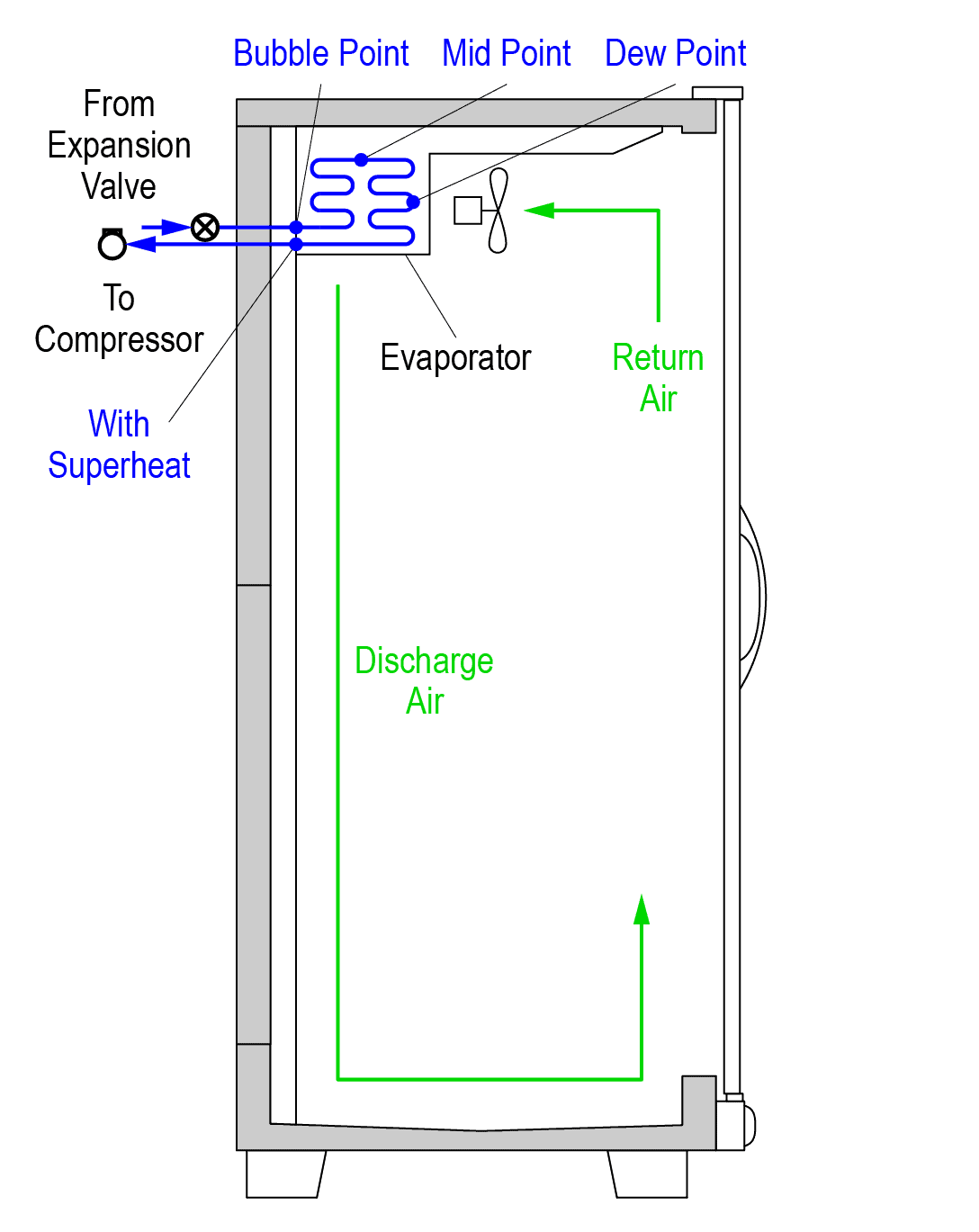
For refrigerants without a glide, it is simpler to design a system because the refrigerant boils at the same temperature throughout the operation. But with high-glide refrigerants, the equipment could be designed for either when the refrigerant starts to boil (evaporate), when it has partially boiled, or when it has fully evaporated.
Refrigeration engineers and service contractors need to be familiar with the terms bubble point, mid point, and dew point.
- Bubble point: Liquid refrigerant starts to boil at this pressure and temperature in the evaporator.
- Mid point: Half of the liquid refrigerant has boiled away to a gas.
- Dew point: The last of the liquid refrigerant boils away.
To remember these terms, think about how a liquid bubbles as it boils or how dew forms in the morning when water vapor condenses.
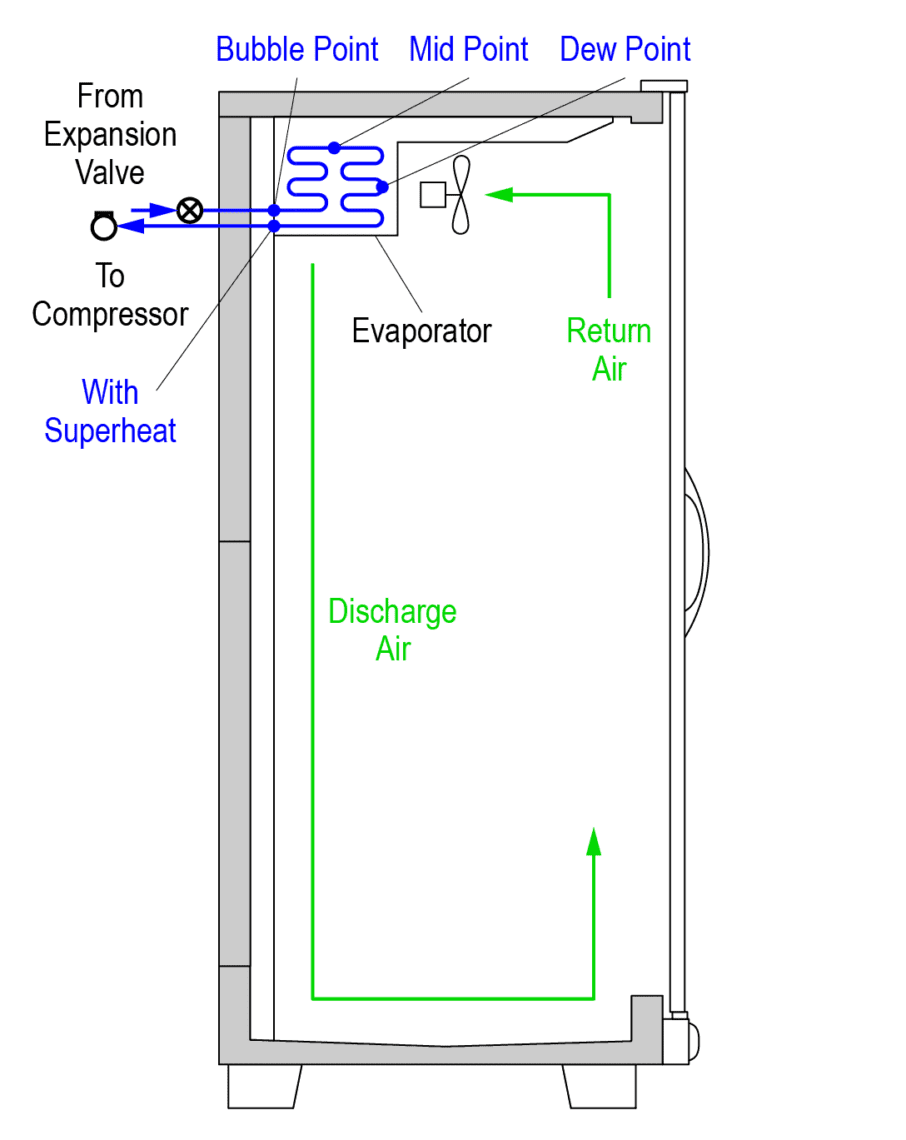
The terms bubble point and dew point need to be understood and applied when discussing high-glide refrigerants. If the equipment does not specify bubble or dew point, the contractor could operate it incorrectly. Bubble point and dew point can be very different, as seen in the previous example (18°F versus 28°F). Warning: If there is ambiguity about whether equipment was designed for dew point, mid point, or bubble point, ask the equipment manufacturer. Do not make assumptions and risk damaging the equipment by running it incorrectly.
Consider This
There are two things worth mentioning to further our discussion. First, the terms bubble, mid, and dew point must be applied differently when talking about condensers on the high side of the refrigeration cycle. The condenser starts at the dew point as vapor refrigerant begins to condense into a liquid, and it finishes at the bubble point as the vapor refrigerant completely condenses into a liquid.
Second, there are also low-glide refrigerants. Low-glide refrigerant blends do not separate as much as high-glide refrigerants when they boil, so the bubble point and dew point are closer together. However, even a small temperature difference affects how equipment is sized and used. It is still important to know the difference between bubble point and dew point for any refrigerant that has a temperature glide.
These are just the basics about temperature glide, but hopefully you can already understand the importance of knowing the terms bubble point, mid point, and dew point.
Using High-Glide Refrigerants
High-glide refrigerants are more complex because of the glide. Why would someone want their system to use high-glide refrigerants? These blended refrigerants were developed specifically to have less of an impact on the environment. Older synthetic refrigerants had high ozone depletion potential (ODP) and high global warming potential (GWP). Refrigerant manufacturers have developed high-glide refrigerants to have low or no impact on the ozone layer and global warming. High-glide refrigerants are gaining popularity because of this, but the glide leads to some new challenges when designing and servicing a refrigeration system.
Have questions? Contact us and ask for our Director of Regulatory Compliance & Refrigeration Technology.
We take our home refrigerators for granted. We put food into the refrigerator, and it makes the food cold. But actually, the refrigerator is not making the food cold; it is removing heat from the food. That might sound counterintuitive, so we invite you to open the door to the world of refrigeration by learning about the basics of the refrigeration cycle.
Heat Transfer & Pressure
Before we discuss the refrigeration cycle, we must briefly discuss heat transfer. Heat always transfers from warm to cold. You can see evidence of this in your beverage of choice. Your morning coffee may start hot, but as the day wears on, it gets cooler because heat transfers into the surrounding air. At lunch, your soda warms up as heat transfers from the surrounding air. This is called sensible heat transfer. You can remember this by thinking about how you can sense (feel) the change. The coffee mug feels hot as heat transfers to you; the soda can feels cold as heat transfers from you.
Heat transfer can also cause a substance to change state between solid, liquid, and gas. This is called latent heat transfer. For example, H2O can exist as a solid (ice), a liquid (water), or a gas (steam). At sea level, H2O will be water between 212°F (100°C) and 32°F (0°C). If water is heated beyond 212°F, it will evaporate into steam. If water is cooled below 32°F, it will freeze into ice. As a substance changes state, its original state will be reduced as the other state increases. For example, as ice melts, it disappears and the amount of water increases. If enough heat transfers, the substance will cease to exist in its original state. Latent heat transfer (changing state) takes more heat than sensible heat transfer (changing temperature).
Another factor is how pressure relates to temperature. Boiling points vary depending on the pressure surrounding the substance. At sea level, water boils at 212°F, but if you travel to Denver or Pikes Peak in Colorado, the atmospheric pressure is lower and the boiling point will be lower.
The Refrigeration Cycle
Your unfinished can of soda is now warm. How do you chill it again? You may think the answer is to add cold to it, but remember that heat only moves from warm to cold. It is more accurate to say that you are actually removing the heat from the soda by transferring that heat to another, colder object. This is the concept behind the refrigeration cycle.
The refrigeration cycle comes from the work of William John Macquorn Rankine, who discovered how to transfer heat away from objects that were already cool. Historically, this could be done by placing objects into an ice box. Ice works well as a refrigerant because it maintains a constant 32°F temperature. Warm product (milk, meat, etc.) transfers heat to the ice (latent heat transfer), causing the ice to melt into water. The water (full of heat) drains away, and the refrigerated space and product remain cool.
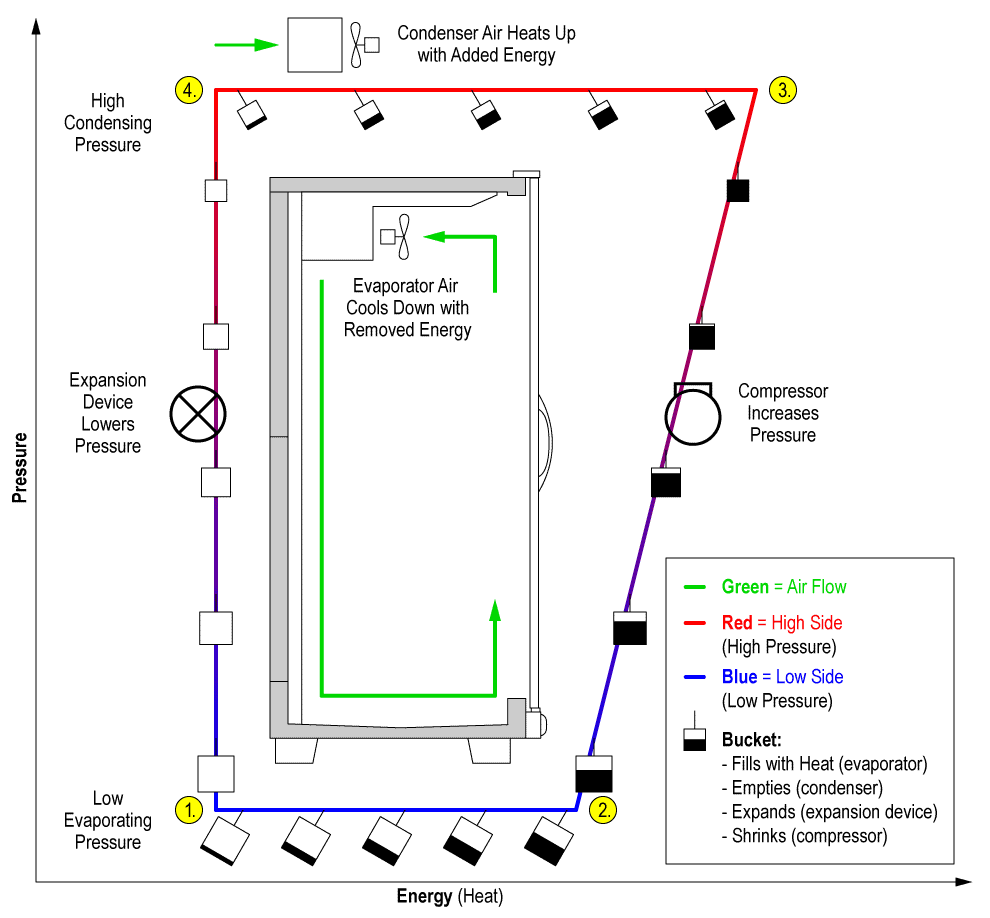
All modern refrigeration systems have four main components that work together to move heat: the evaporator, the compressor, the condenser, and the expansion device. Imagine that heat moves in a “bucket” and follow the bullet points which correspond to the figure.

- The evaporator gathers/absorbs heat from the refrigerated space into a “bucket.” The “bucket” is low-pressure, and it changes state (latent heat transfer) as it absorbs heat. Then the evaporator moves the low-pressure, heat-filled “bucket” to the compressor.
- The compressor applies pressure, which compresses the heat-filled “bucket.” The heat-filled “bucket” changes from low-pressure to high-pressure as the compressor pushes it from the colder evaporator to the warmer condenser. When pressure is added, the temperature of the “bucket” also increases.
- The condenser takes the high-pressure, heat-filled “bucket” and releases the heat from the “bucket” to the outside air (or other application). The “bucket” changes state (latent heat transfer) again as it releases heat.
- The expansion device relieves the pressure on the empty “bucket.” When pressure is reduced, the temperature also decreases. The “bucket” cools and expands on its way to the evaporator to absorb more heat again.
The downside of using ice as the “bucket” is that more ice must constantly be added as it melts away. Modern refrigeration systems needed a long-term solution. Refrigerants are the modern “bucket” because refrigerants can continually absorb and release energy without escaping the system. Refrigerants change state between a liquid to a gas. Refrigerants must be able to boil at low pressures and low temperatures to be efficient.
High-glide refrigerants have a unique effect on a refrigeration system.
Have questions? Contact us and ask for our Director of Regulatory Compliance & Refrigeration Technology.
When making your New Year’s resolution, you possibly resolved to save more and spend less. How can retailers like you continue to save money with your commercial refrigeration equipment?
Every grocery store requires thousands of kilowatt-hours (kWh) of electricity per year to operate. This electricity covers refrigeration, ventilation, lighting, cooking, heating and cooling, and office. But the overwhelming majority of electricity goes to commercial refrigeration equipment that runs whether the store is open or not. This makes refrigeration an obvious target for energy and cost savings.
Through some simple investigation and adjustments, you could benefit from energy savings. Check out some steps our product managers and engineering team recommend to get the most out of your commercial refrigeration equipment.
Evaluate Energy Consumption
First, collect data about the energy that your commercial refrigeration equipment uses by referring to the component specification sheets. You should verify that the equipment is operating at the specified temperatures. If not, the controls could be set too cold, which wastes energy, or there could be a performance issue such as an iced coil or low refrigerant charge. If you notice equipment is not operating correctly, contact your refrigeration contractor.
You can also contact your utility company. Ask if they can perform an energy audit to compare your energy usage to similar businesses that use commercial refrigeration equipment. They may even suggest ways to improve the efficiency of your equipment.
In addition to checking your commercial refrigeration equipment, look at your HVAC system settings. Refrigerated display cases are designed to operate in ambient temperatures of 75°F and 55% relative humidity (defined by ASHRAE). Ensuring that your HVAC equipment maintains good store conditions will reduce commercial refrigeration equipment energy consumption, and it is more cost effective to have the HVAC equipment cooling the store instead of having the display cases dehumidifying it.
Install Energy-Saving Features
There are many features available that are designed to reduce energy usage and provide cost savings down the road for your commercial refrigeration equipment.
Motion sensors, which turn display case lights off when no shoppers are around, have a relatively quick payoff. Anti-fog coating is a clear film on doors that prevents fog buildup and helps shoppers see products. Over time, this leads to energy savings because the case does not get opened unnecessarily, which means less energy is consumed to cool the case. Most display cases come with standard anti-sweat heaters that limit door sweating in humid conditions, but they can run too aggressively in cooler, drier stores. Consider ordering your next display case with an anti-sweat controller, which cycles the heaters off when there is less humidity in the air, thereby saving energy. Also contact your refrigeration manufacturer. They may be able to offer other features to reduce energy consumption for your commercial refrigeration equipment.
Schedule Routine Maintenance
It pays to be proactive and schedule regular maintenance for your commercial refrigeration equipment. Instead of waiting for an issue to happen, you should schedule regular visits from your refrigeration contractor to keep the equipment running efficiently and catch component failures early.
General cleaning and maintenance is important for efficient case operation. You should clean doors and windowed ends so people can see product. Regularly clean lint and dust accumulation off of condenser coils and discharge air grills. On a monthly basis, ensure gaskets are not torn, doors are at ideal tension, and all fans are operating.
To check gaskets, simply place a dollar bill in the door track. If the dollar slides out with little to no resistance, it’s time to have the seals replaced or adjusted. To check ideal door tension, open the door and observe how well it closes. A properly tensioned door will close itself gently and not swing open. If the door does not close or swings open, the case will not operate optimally. There are two ways to check fan operation. One way is to put your hand near the discharge air grills. If all fans are working, the airflow will be the same from door to door. If less air is coming out, a fan may not be working. However, the most effective way to check fan operation is to unload product, take out the cover, and visually confirm that the fan is working. Do not put your hand into the fan, even if it appears to not be operating.
With so many steps available for reducing your refrigeration energy consumption, it is wise to develop a plan. Even if the budget does not allow for a full equipment overhaul, you may be able to update your cases department-by-department. That allows you to stay within budget, and your New Year’s resolution will be off to a good start!
Maximize your savings this year! Contact us to learn more about energy-efficient commercial refrigeration equipment solutions.
The California Air Resources Board (CARB) has officially published details about the California Cooling Act, which will take effect on January 1, 2019. The Act, which is based on vacated EPA SNAP Rule 20, prohibits HFC refrigerants with high global warming potential (GWP)—such as R-404A and R-507A—for supermarket systems, condensing units, and self-contained units.
The California Cooling Act affects new and retrofit equipment. Manufacturers cannot sell equipment using prohibited refrigerants that are manufactured after January 1, 2019.
CARB Definition for New Refrigeration Equipment:
- Any refrigeration equipment that is first installed using new or used components; or
- Any refrigeration equipment that is modified such that it is:
- Expanded after the date at which this subarticle becomes effective, to handle an expanded cooling load by the addition of components in which the capacity of the system is increased, including refrigerant lines, evaporators, compressors, condensers, and other components; or
- Replaced or cumulatively replaced after the date at which this subarticle becomes effective, such that the capital cost of replacing or cumulatively replacing components exceeds 50 percent of the capital cost of replacing the entire refrigeration system.
If the retailer or engineer is unsure whether the work will classify as a new system, they should contact the Refrigerant Management Program Hotline at 916-324-2517 or rmp@arb.ca.gov.
Additional Reading:
Refer to the following for more information about California’s regulations or the EPA regulations that affect the rest of the country:
For further information, contact Zero Zone at 800-247-4496 and ask for our Department of Regulatory Compliance and Refrigeration Technology. This message is informational only, and customers should review the new regulations fully to ensure compliance.
The United States Environmental Protection Agency (EPA) regulates which refrigerants may be used and how refrigerants must be handled. It is important to note that individual states may write their own refrigeration regulations above and beyond the EPA regulations.
Since 2015, EPA has proposed several rules, but some of those rules have been vacated in court. We understand that it may be confusing which rules still apply. Please read below to understand which regulations will come into effect in January 2019.
SNAP Program, Prohibited Refrigerants, and California
What is the SNAP Program?
EPA regulates which refrigerants may be used for new or retrofit refrigeration through the Significant New Alternatives Policy (SNAP) program.
Which refrigerants were affected by recent EPA rules?
EPA released Rule 20 and Rule 21 through its SNAP program, which delisted refrigerants with high global warming potential (GWP). This prohibited common refrigerants such as R-134A, R-404A, and R-507A. However, EPA was challenged in court and lost on Rule 20, which means it has been vacated and will not go into effect. It is possible that Rule 21 will also be vacated, but the courts are still evaluating it. Use the links below for more information:
Can high GWP refrigerants be used?
Yes, depending on state. Rule 20 was vacated on a national level, but individual states may pass their own refrigeration regulations. In 2018, California passed a regulation that adopts Rule 20 (called Rule 1 in California). This rule prohibits high GWP refrigerants in California after January 1, 2019. More information is available on California legislature’s website: http://leginfo.legislature.ca.gov/faces/billNavClient.xhtml?bill_id=201720180SB1013
High GWP refrigerants can continue to be used in all other states, but that may change too. California is a member of the United States Climate Alliance (USCA), and the other states will likely adopt similar regulations. This includes Colorado, Connecticut, Delaware, Hawaii, Maryland, Massachusetts, Minnesota, New Jersey, North Carolina, Oregon, Rhode Island, Vermont, Virginia, and Washington.
In summary, R-134A, R-404A, and R-507A may be used in all states except California, which prohibits those refrigerants. However, other states in the USCA are likely to prohibit those refrigerants in the coming years.
Section 608, Record Keeping, and Leakage Rates
What is Section 608?
EPA regulates how refrigerants are handled through Section 608 of the Clean Air Act. Section 608 affects many sectors in the refrigeration industry:
- Technician Certification
- Refrigerant Recovery and/or Recycling Equipment
- Refrigerant Leaks
- Refrigerant Sales
- Record Keeping
- Safe Disposal
- Reclamation
- Service Practices
For more detail on how Section 608 applies, visit https://www.epa.gov/sites/production/files/2018-09/documents/section_608_of_the_clean_air_act.pdf
What are the new Section 608 regulations?
EPA issued new regulations that 1) require owner/operators to keep additional records for their refrigeration systems, and 2) change the allowable leakage rates for refrigeration systems. These rules affect ozone depleting refrigerants and will take effect on January 1, 2019.
The new rule included refrigerants with high GWP such as R-134A, R-404A, and R-507A. However, EPA proposed to omit refrigerants with high GWP from the rule. This has not been finalized, so more information will be provided as it becomes available. Use the links below for further reading.
What records does an owner/operator need to keep?
- Full System Charge
- Service Work Invoices
- Installation and Calibration of Automated Leak Detection System (if applicable)
- Leak History
- Reports for Leakage Rate Greater than 125% of Full-Charge in a Year
- Retrofit or Retirement Plans
- Requests to the EPA
- System Mothballing Reports
- Seasonal Variance Records
What are the allowable system leakage rates?
EPA reduced the allowable leakage rates. Annual leakage rates are calculated as a percentage of the full system charge. Details for calculating leakage rates can be found at https://www.epa.gov/sites/production/files/2016-09/documents/608_fact_sheet_supermarkets_property_managers_0.pdf.
| Allowable Leakage Rate Before Retiring or Replacing |
Old rule |
New rule |
| Commercial Refrigeration |
35% |
20% |
| Comfort Cooling |
15% |
10% |
| Industrial Process Refrigeration |
35% |
30% |
What must be done when a leak is found?
If leakage rate exceeds allowable rates, the system must be repaired, retired, or replaced.
Repair: If a leak is repaired, the technician must ensure the system is leak-free before adding refrigerant. After refrigerant is added, the technician must check the repair again after the system returns to normal temperatures and pressures. Information for technicians can be found at https://www.epa.gov/sites/production/files/2016-09/documents/608_fact_sheet_technicians_0.pdf.
Retire or Replace: Owner/operators must develop a retrofit or retirement plan within 30 days if the leak cannot be repaired. The plan must be implemented within 1 year. If the leak is repaired within 180 days, the plan can be terminated and the system can be used.
What must be done after a leak?
After a leak, systems must be checked for leaks based on the schedule below. All visible, accessible parts of the systems must be inspected.
- Refrigeration systems with over 500 lb. refrigerant charge must be inspected every 3 months until the leakage rate is below the annual requirement.
- Refrigeration systems with between 50 and 500 lb. refrigerant charge must be inspected every year until the leakage rate is below the annual requirement.
- Refrigeration systems with a leak detection system do not require regular leak inspections. However, the leak detection system must be calibrated annually.
When should a leak be reported to EPA?
If the annual leakage rate of a refrigeration system exceeds 125% of the full charge within a calendar year, owner/operators must notify EPA by March 1 of the subsequent year and describe their efforts to identify and repair leaks.
Vacated EPA SNAP Rule 20 Allows R-404A for Refrigeration Equipment
Background on SNAP Rule 20
Refrigerant regulations have significantly impacted the industry. In 2015, the United States Environmental Protection Agency (EPA) issued SNAP Rule 20 to prohibit the use of certain hydrofluorocarbons (HFCs) that were previously acceptable substitutes for ozone-depleting substances. Consequently, Rule 20 required refrigeration equipment manufacturers like Zero Zone to phase out specific refrigerants, including R-404A and R-507A.
Legal Challenge and Overturning of Rule 20
However, parties challenged Rule 20, contending that the EPA SNAP Program could not be used to phase out HFCs that did not deplete ozone. The D.C. Circuit Court of Appeals overturned Rule 20, and despite an appeal, the court’s decision stood. As a result, on February 5, 2018, Rule 20 was vacated, allowing R-404A and R-507A to be used in new and retrofit refrigeration equipment once again.
Immediate Changes in Refrigerant Availability
Starting immediately, Zero Zone offers a variety of refrigerants, including R-404A and R-507A, for rack systems and remote display cases. Additionally, Zero Zone Hybrid™ cases can be ordered with either R-404A or R-448A. Hybrid™ cases utilizing R-404A will be available for shipment by April 1, 2018. Similarly, display cases using remote condensing units can be ordered with either R-404A or R-448A, with remote condensing units utilizing R-404A available for shipment by April 1, 2018.
Future Considerations for Refrigerant Regulations
This change does not phase out R-448A or any of the lower GWP refrigerants approved by SNAP. Customers may want to order R-448A or other lower GWP refrigerants in preparation for any future regulations. For example, the California Air Resources Board (CARB) has proposed legislation to implement SNAP Rule 20 in September 2018 for the state of California. It is possible that other states will make similar rulings. Therefore, lower GWP refrigerants may still be the best option for many customers. Customers need to evaluate which refrigerant will be best for their situation.
Contact Information
For further information, contact Zero Zone at 800-247-4496 and ask for our Department of Regulatory Compliance and Refrigeration Technology. This message is informational only, and customers should review national and local laws and regulations to ensure compliance.
By focusing on refrigerant regulations, this text aims to provide clarity on the changes and future considerations for customers in the refrigeration industry.
Zero Zone is proud to announce we have partnered with Honeywell and Festival Foods to design and install equipment for use with R448A refrigerant instead of the previously used R404A refrigerant. Festival Foods made this decision after much collaboration with John’s Refrigeration, Honeywell, and Zero Zone employees. The R448A system will give Festival Foods what they were looking for in terms of performance and regulatory needs in their stores, including but not limited to, a lower GWP, easy serviceability, and energy efficiency. We look forward to working with Festival Foods, Honeywell, and John’s Refrigeration on many more projects!
To read the article published in Cooling Post, click on the following link Festival Foods opts for R448A
Congratulations to Whole Foods Market Dublin on the 2017 EPA Award
Zero Zone congratulates Whole Foods Market in Dublin, California, for receiving the prestigious 2016 Platinum Certification through the EPA GreenChill Partnership. This EPA Award is given to GreenChill-certified stores that demonstrate exemplary advancement in reducing emissions of environmentally harmful refrigerants.
Achievements and Recognition
Whole Foods Market Dublin earned this recognition by using a state-of-the-art refrigeration system. Specifically, they employed the Zero Zone ColdLoop™ Cascade Ammonia/CO2 with an Adiabatic Air-Cooled High Side Condenser. This innovative system played a crucial role in their achievement, showcasing their commitment to environmental sustainability.
Whole Foods Dublin did not stop at the Platinum Certification. They also tied with the Piggly Wiggly store in Columbus, GA, for the title of “the best GreenChill certified store of all stores certified in the past year” in 2016. This additional accolade further underscores their dedication to excellence in refrigeration practices.
Zero Zone’s Contribution
Zero Zone is extremely proud to have supplied the refrigeration system that helped Whole Foods Dublin achieve this highly regarded EPA Award. Our cutting-edge technology and commitment to sustainability align perfectly with the goals of the GreenChill Partnership. We are thrilled to see our systems making a positive impact.
Future Implications
This achievement by Whole Foods Dublin sets a benchmark for other stores aiming to reduce their environmental footprint. As regulations and standards continue to evolve, businesses must adopt advanced refrigeration systems that minimize harmful emissions. Zero Zone remains committed to providing solutions that meet these stringent requirements and support our customers in achieving their sustainability goals.
Learn More
For further information about Whole Foods Market’s award and the innovative refrigeration systems that contributed to their success, please contact Zero Zone at 800-247-4496 and ask for our Department of Regulatory Compliance and Refrigeration Technology. This message is informational only, and customers should review national and local laws and regulations to ensure compliance.
Way to go, Whole Foods Dublin! Your achievements inspire us all to strive for excellence in environmental stewardship.
Learn more about Whole Foods Market’s award here!