The American Innovation and Manufacturing (AIM) Act directs the EPA to phase down hydrofluorocarbons (HFCs) and transition to alternative refrigerants. The phasedown began in 2022 and continues through 2036. In October 2023, the EPA finalized the Technology Transition Rule, which sets guidelines for new system installations, retrofits and remodels, and the disposal of older systems. In September 2025, the EPA proposed a new technology transition rule, signaling ongoing regulatory updates as the phasedown progresses. No changes are official until the rule is finalized and published in the Federal Register.
Subscribe to our newsletter to stay up to date on these regulations.
Last month, we discussed the ways in which industrial and commercial refrigeration systems can achieve greater energy efficiency using modern components.
This month, we will delve into the advancements in commercial reach-in freezers and coolers, commonly known as refrigerated display cases within the industry. We will explore how these units have been optimized for efficiency and effective cooling with the integration of the latest refrigeration technology.
Now that we have crossed into 2025, the first restrictions of the American Innovation and Manufacturing (AIM) Act are now in effect. The AIM Act of 2020 allows the EPA to restrict the production, import, and use of hydrofluorocarbons (HFCs). HFC refrigerants have a high global warming potential (GWP) and are being phased down by 85% through 2035.
The Refrigerants allowed by the AIM Act are not direct substitutes for HFC refrigerants. Refrigeration systems require different components, piping and programming with each refrigerant. The performance of refrigeration systems is influenced by the external ambient temperatures.
Equipment installed before restrictions go into effect are allowed to maintain operation throughout their useful life. This includes service, parts, and refrigerant. However, the availability of each is dependent on the manufacturer.
Retrofitted equipment and new installations have their own regulations and definitions. Retrofitted equipment, replacing at least 75% or more of the evaporators and 100% of the compressor racks, condensers, and connected evaporator loads of an existing system, will need to follow the restrictions for a new installation. For more information on the AIM Act and state regulations, visit our Refrigerant Regulations webpage.
Flexibility and Durability of Hybrid™ Merchandisers
The Hybrid™ merchandiser offers the flexibility of a self-contained display case while maintaining the durability and sales capability of those in large supermarkets. Each Hybrid™ merchandiser inherits the traits of its remote counterpart and has all the necessary refrigeration components mounted on top of the display case. These cases require minimal effort to install. After connecting the remote condensing unit to the display case, they are ready to be energized for operation. With medium- and low-temperature options, you can display beverage, bakery, dairy, deli, floral, frozen food, meat, produce, or seafood products in an environment that will keep them fresh.
Benefits for Stores of Any Size
Zero Zone Hybrid™ merchandisers provide benefits for a store of any size. They allow small format stores to effectively and efficiently use their floorspace for merchandising products rather than taking up valuable real estate for the refrigeration system. Additionally, large format retailers can add a Hybrid™ merchandiser to the sales floor without increasing the installed system’s load or the need for additional refrigeration piping.
The Highlight Merchandiser® is a durable display case that exudes classic charm. This workhorse not only offers a generous packout but also provides a spectacular, full view of your product. Whether you need to protect frozen food, ice cream, beverages, dairy, deli items, meat, ice, or produce, the Highlight Merchandiser® rises to the occasion. Moreover, its robust construction ensures longevity, while its elegant design enhances the visual appeal of any retail space. Thus, the Highlight Merchandiser® seamlessly combines functionality and aesthetics, making it an ideal choice for showcasing a wide variety of products.
Zero Zone reliability has built a trust with customers across North America. This trust grew from our small town in Wisconsin by selling to local retailers, such as Webster’s Marketplace. When Webster’s Marketplace expands, they choose Zero Zone for their refrigerated display cases. DuWayne Wichman, one of the store directors, has said in an interview, “I can’t say enough good things about [Zero Zone refrigerated display cases].” Inside Webster’s Marketplace, you’ll find Zero Zone display cases in operation from 1984, 2005, 2015, 2017, and 2024.
The Reveal Merchandiser®
The Reveal Merchandiser® aligns with the diversity of your product by offering a variety of features. Specifically, it provides options for beverages, dairy, deli, meat, and produce. Additionally, the multitude of lighting, shelf, and accessory choices empowers you to take control of creative merchandising.
The Lineup
Before we can accessorize a display case, we have to know what we are working with. Zero Zone has four models for the Reveal Merchandiser® display case.
The Zero Zone Crystal Merchandiser® is more than a display case to keep your products cold, it is used to show off your product’s best features. Crystal Merchandiser® applications include floral displays, produce, dairy, deli, wine, beverages, ice cream, and frozen foods. The versatility of the Crystal Merchandiser® applications does not end with what can be displayed, but how its contents can be displayed.
What is the AIM Act?
The American Innovation and Manufacturing Act (AIM Act) was passed in 2020 by bipartisan support in the U.S Congress as the United States joined the global movement to reduce human impact on climate change. The AIM Act directs the U.S. Environmental Protection Agency (EPA) to oversee the phasedown of HFC refrigerant production and consumption in an effort to transition to alternative refrigerants. The AIM Act includes a phasedown schedule that began in 2022 and continues to 2036.
The new rule prohibits the manufacture and import of self-contained products that use hydrofluorocarbons (HFCs). The rule also prohibits the sale, distribution, and export of products three years after the manufacture and import restriction. Finally, it prohibits the installation of new refrigeration air conditioning and heat pump (RACHP) systems that contain HFCs. The compliance dates of these new rules vary based on sector and subsector.
Who does the AIM Act refer to?
The final rule states, “Entities that manufacture, import, export, sell, distribute, or install systems or products that use HFCs in refrigerants and air-conditioning equipment systems, heat pumps, foams, and aerosols may be affected by this new rule. Restrictions apply to original equipment manufacturers, product distributors, retailers, and companies that direct the installation of new RACHP systems.”
Important definitions
The final rule makes a distinction between products and systems. Certain products and the installation of certain systems have different restrictions.
A product is functional upon leaving a factory. Examples of products include self-contained refrigerators and self-contained ice machines. The EPA is restricting the sale, distribution and export of products containing higher-GWP HFCs three years after the manufacture and import restriction dates.
A system is assembled and charged in the field using multiple components. An example of a system is a supermarket refrigeration system that include a centralized compressor room. Components include equipment such as compressors, condensers, and display cabinets. There is not a restriction on the manufacture, import, sale, distribution, or export of components that are used to repair existing systems.
When will the phasedown start?
Industrial Phasedown
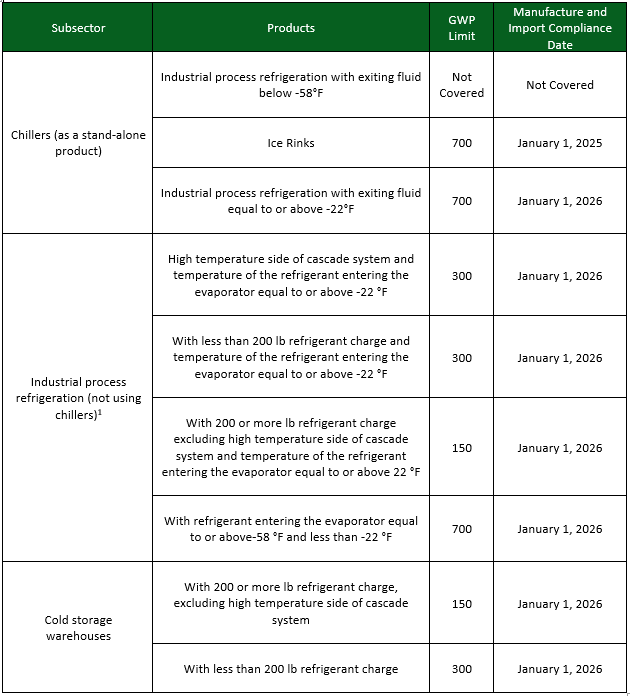
Retail Phasedown

Notes:
- Industrial Process Refrigeration (IPR) systems are used to cool process streams at a specific location in manufacturing and other industrial processes (e.g., chemical, pharmaceutical, petrochemical, and manufacturing industries).
- Refers to the Zero Zone Hybrid™ display cases and rack condensing units (Edge XT).
- Refers to Zero Zone’s Highlight®, Crystal®, and Reveal® display cases and their associated systems.
Why was the AIM Act proposed and passed?
The AIM Act addresses petitions from industry, environmental organizations, and state governments to restrict the use of HFCs. The EPA has estimated the potential benefits of this rule will provide savings to American consumers and industry through energy efficiency and lower-cost refrigerants. The EPA stated that this rule will also result in greenhouse gas emissions reduction benefits.
- EPA estimations:
- Emission reduction of 876 million metric tons of carbon dioxide equivalent through 2050.
- $50.4 billion in climate change mitigation benefits
- $4.5 billion in cost savings to consumers and businesses driven by the lower cost of HFC substitutes and increased energy efficiency of lower-GWP refrigerants
For our customers
This rule does not restrict Zero Zone customers from using their existing refrigeration systems. The EPA has allowed an existing system to continue its operation to the end of its useful life. The systems may be serviced and repaired throughout their use, including replacing components. Components needed for repair are allowed to continue being manufactured.
For new installations, the equipment needs to be charged before the compliance dates. The following actions are considered a new installation:
- Assembling a system for the first time from used or new components;
- Increasing the cooling capacity, in BTU per hour, of an existing system; or
- Replacing 75 percent or more of evaporators (by number) and 100 percent of the compressor racks, condensers, and connected evaporator loads of an existing system.
Into the Future: Refrigerant Management
Although a system can be serviced until the end of its useful life, the refrigerants used to recharge it will become scarce as production slows. The costs of synthetic refrigerants are expected to rise. The EPA is currently working on a standard for refrigerant reclamation and requirements for reclaimed HFC refrigerants. They are proposing that as of January 1, 2028, reclaimed refrigerant must be used when servicing and/or repairing refrigerant-containing equipment. This includes supermarket systems and stand-alone retail food refrigeration.
If you have questions about these regulations, please contact Zero Zone and ask to speak to our Director of Regulatory Compliance & Refrigeration Technology, Bruce Hierlmeier.
How can Zero Zone Help?
At Zero Zone, we’ve always been green. Zero Zone offers sustainable refrigeration solutions with Genesys™ Natural Refrigeration Solutions. If you want to learn about our offerings and plans for these new regulations, contact our sales team or visit Zero Zone’s Genesys™ Natural Refrigeration Solutions webpage.
View the infographics for our Retail and Industrial customers for a summary of important facts and dates.
What changed?
The Environmental Protection Agency (EPA) finalized the phasedown schedule (above) for hydrofluorocarbons (HFCs), which is mandated by the American Innovation and Manufacturing Act (AIM Act). There were no changes between the proposal and the final rule. The schedule still calls for a segmented reduction in HFCs produced and consumed, ending in an 85% reduction by 2036.
The finalized rule includes an allocation and trading program, which determines the amount of refrigerant that may be produced and consumed. There were no changes between the proposal and the final rule.
Who is impacted by the AIM Act?
- Refrigerant Producers: Companies that produce, import, export, destroy, reclaim, or recycle HFCs are issued allowances by the EPA on October 1 of each year. These allowances are relative to the phasedown schedule.
- End Users: Companies that use refrigeration equipment—such as retailers, cold storage warehouses, and industrial process facilities—will feel an indirect impact because HFC refrigerant will be less common and more expensive.
We know from the recent phaseout of R-22 that this phasedown will cause refrigerant prices to rise. HFC refrigerants that are manufactured will primarily be used to service leaks in existing systems, plus HFC refrigerants are shared with other industries, such as air conditioning and foaming processing. This could impact cost and availability of refrigerants to retailers and industrial end users, meaning that budgets for repairs will need to increase.
What should retailers and other end users do?
To counteract this, Zero Zone recommends that future orders for refrigeration equipment should be switched to alternative refrigerants sooner than later, such as natural refrigerants and low-GWP HFO-based refrigerants. This will make service costs better in the long run. Plus, it will prepare end users for upcoming EPA rules that will further regulate refrigerants.
What other rules are coming?
The refrigeration industry awaits three more final EPA rules.
1) The EPA proposed a rule that will establish limits by 1/1/2025 on the global warming potential (GWP) of refrigerants. This rule must be finalized in October 2023. Below are the current GWP restrictions proposed.
These GWP limits will end the use refrigerants such as R-404A (GWP of 3943), R-407A (GWP of 1923), R-410A (GWP of 1924), R-448A (GWP of 1273), R-449A (GWP of 1282), and R-507 (GWP of 3985) in new equipment. Going forward, refrigeration equipment will need to use natural refrigerants, such as CO2 (GWP of 1), ammonia (GWP of 0), and HFO-based refrigerants with GWP less than the limits.
2) The refrigeration industry also awaits the release of EPA Rule 26, which will allow for the use of A2L refrigerants in commercial and industrial applications. “A2L” refers to an ASHRAE classification of refrigerants that are mildly flammable. Rule 26 would also increase the allowable R-290 (propane) charges for self-contained equipment.
3) The EPA will be updating Section 608 of the EPA Clean Air Act (CAA), which regulates handling, recovery, reclamation, and recycling of refrigerants. They are updating the rule for how service technicians can handle refrigerants and how refrigerant use is reported by store owners.
Further Reading
For more information about upcoming EPA regulations: “The National Plan for Refrigerant Regulations.”
For more information about current state regulations: “The State of Refrigerant Regulations.”
If you have questions about these regulations, please contact Zero Zone and ask to speak to our Director of Regulatory Compliance & Refrigeration Technology. If you want to learn about our offerings and plan for these regulations, contact our sales team.

 Notes: